Your agent’s reliability, measured.
Hone reads what your agents actually do in production — the failures your evals never caught — and turns it into one reliability score you can act on. LangGraph, Bedrock, voice, or chat.
No credit card. Connect one agent in under five minutes.
Your agent is failing customers.
You can’t see it.
Agents don’t crash when they fail — they hallucinate an answer, skip a tool, or talk a customer in circles, and move on. Your uptime is green, your evals pass, and no one owns the gap between “the service is up” and “the agent did right by the customer.”
The agent confidently told a customer their claim was approved. It never called the policy API. Nothing errored, no test caught it — you found out from an angry thread days later.
When something breaks, the first human to read the trace is the one engineer who can. Support can't triage it. So every incident routes straight to the person who can least afford to be interrupted.
Aggregate success looks fine while individual customers quietly churn. You can't point at a single figure and say reliability went up this month — so you can't tell if any fix actually worked.
Score it. Triage it. Enforce it.
Three surfaces, one loop — from a silent failure to a number that moves.
Your agent's reliability, in one score
Task success, escalation rate, tool-call success, policy adherence, cost per task — computed from your real traffic and broken out per customer. The figure you defend a budget with.
- Every SLI in one place, per customer and per agent
- Deterministic signals first — trustworthy from day one
- Watch the number move as you fix things
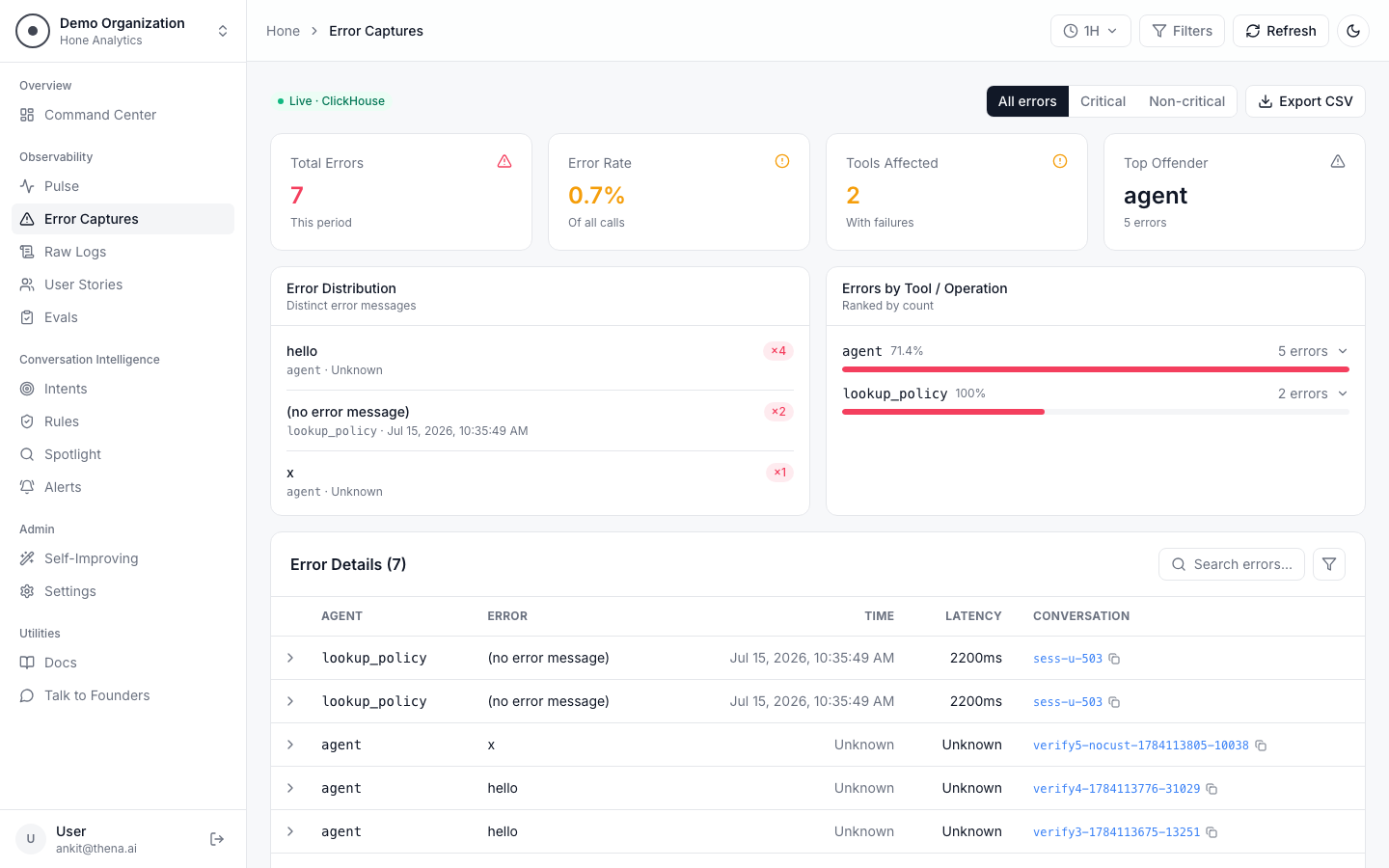
See which customer got burned, and why
Every failure surfaces the moment it happens — including the silent ones no customer reported — keyed to the end customer, ranked by cost, with the full trajectory attached. A triaged queue, not a wall of logs.
- Surfaces failures that never became a ticket
- Grouped by the downstream customer, not by error code
- Jump from a failure straight to the trajectory
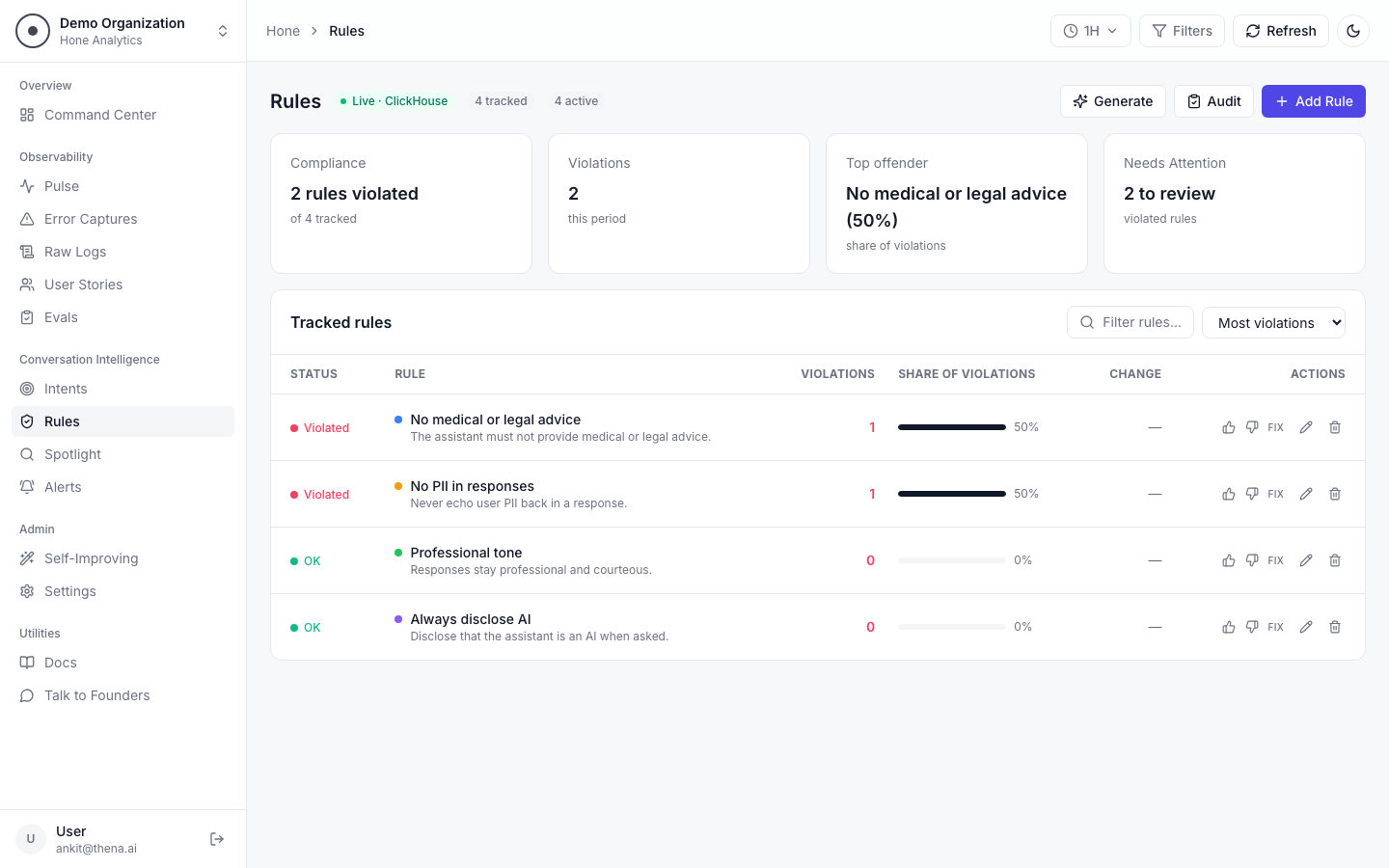
Turn your SOPs into checks that fire live
Codify how your agent must behave — the disclosure it always makes, the promise it can't make before an API returns — in plain language. Hone enforces it against every conversation and flags the moment one is broken.
- Write rules in plain language, no DSL to learn
- Continuous checks against every new conversation
- Built for regulated workflows where one breach is costly
From connect to your first score.
No golden dataset to author, no eval framework to learn. Point Hone at one agent and you have a reliability score the same afternoon.
Connect your agent
Point Hone at your traces with a drop-in SDK, an OTel export, or the Langfuse connector. Every run streams in — no schema changes, no redeploy.
Get your reliability score
Hone reads what your agent actually did, computes the SLIs, and gives you one reliability number per customer — plus the triaged failures dragging it down.
Improve it, at your pace
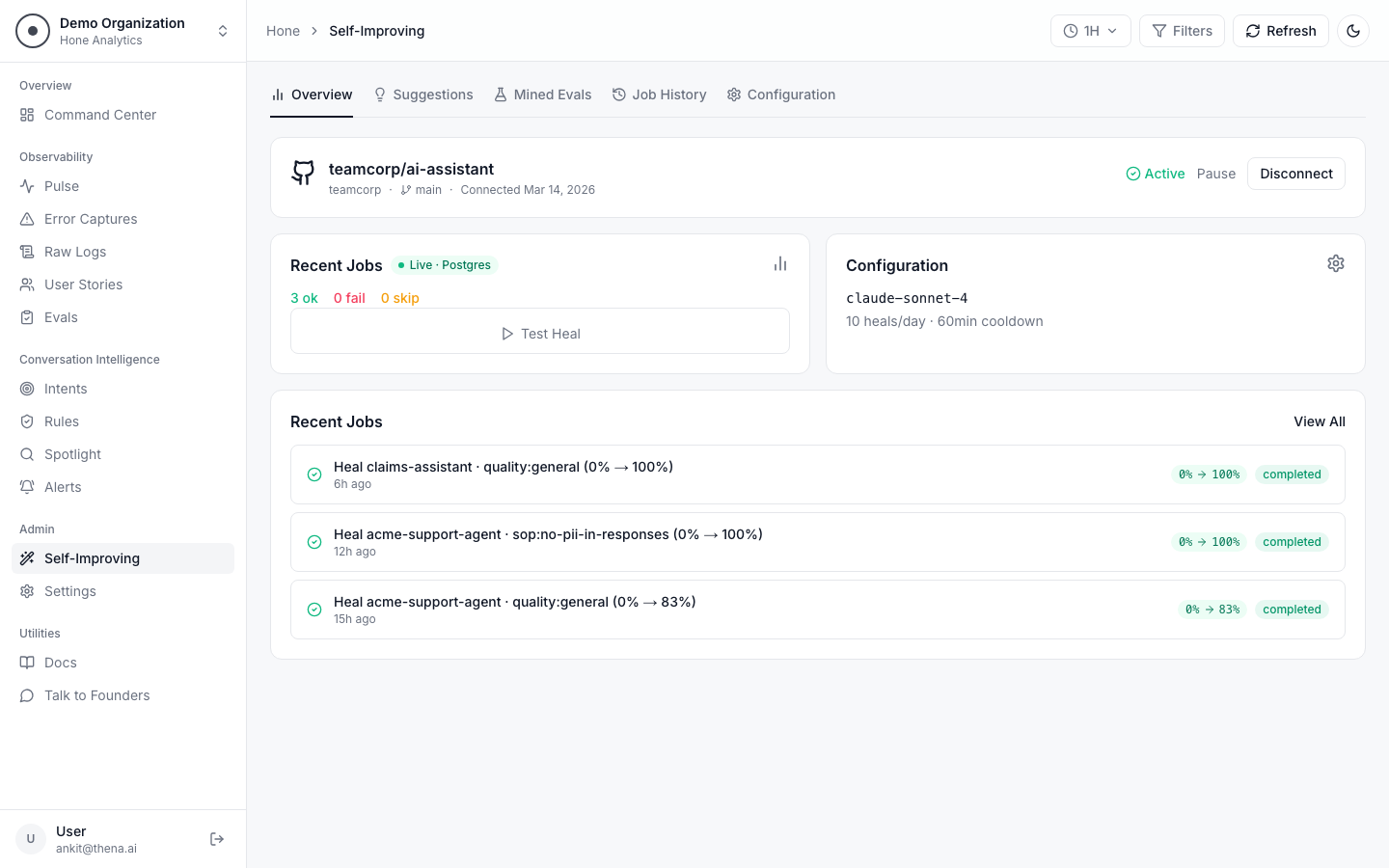
Enforce your policies, and when you're ready, Hone drafts the fixes. It earns autonomy the way a hire does: observe, then recommend, then apply with your approval.
Start free.
Priced per agent, not per seat.
Every plan scores your agent’s reliability and triages failures from your traffic. Upgrade when you want Hone enforcing policy and drafting the fixes.
Free
Wire up one agent and get its reliability score from real production traffic.
Start for free- 1 connected agent
- 10,000 agent runs / month
- Reliability scorecard + SLIs
- Customer-lens failure triage
- 7-day trace retention
- Community support
Pro
For teams whose agents customers depend on — a fraction of one reliability hire.
Start free trial- Up to 10 connected agents
- 2,000,000 agent runs / month
- Policy & SOP adherence checks
- Regression guard on every change
- Fixes drafted for your approval
- 90-day retention
- Slack & email alerts
Enterprise
For fleets of agents, strict compliance, and self-hosting.
Talk to us- Unlimited agents & runs
- Self-hosted or private cloud
- Custom retention & data residency
- SSO, audit logs, RBAC
- Dedicated solutions engineer
- Priority SLAs
Frequently asked
Observability tells you the service is up, how many tokens you spent, and how fast the agent replied. None of that tells you whether the agent did right by the customer. Hone scores the behavioral half — task success, escalations, policy breaches, silent failures — the reliability those tools can't see.
The score starts from failures you can already prove — tool errors, loops, escalations, dropped tasks — no judgment call required. The subtler ones are calibrated against your own labelled outcomes, and every verdict is shown with its evidence so you can check it. You stay in the loop; the score earns your trust, it doesn't assume it.
Evals are one part of it. Most eval tools hand you a harness and make you author the golden dataset. Hone mines the evals from your real traffic and folds them into the wider reliability picture — scoring, triage, policy adherence, and the fix loop — so you're buying a reliability practice, not a blank page.
No. Hone drafts the change, replays it against your real history to check it helps without breaking anything, and opens it for review. Autonomy is earned rung by rung — observe, recommend, apply-with-approval — and it never auto-ships to a regulated agent. A human always merges.
Yes. Hone is model- and framework-neutral — LangGraph, Bedrock, direct model calls, voice, chat. If your agent produces a trace of steps and tool calls, Hone can read it, via a drop-in SDK, OTel, or the Langfuse connector.
Traces are encrypted in transit and at rest, retention is configurable per plan, and you can redact fields before they ever reach us. Enterprise plans add self-hosting, data residency controls, and audit logging — important when your agent is in a regulated workflow.
Yes. Teams run several agents side by side. Hone scores reliability and triages failures per agent and rolls them up, so you can see where any agent — or the whole fleet — is drifting.